Alcohol Culture in Denmark and Greenland
By Dave C & Boozeopedia AI Workflow
See how we write our articles
Denmark and Greenland are connected through the Kingdom of Denmark, but their drinking cultures have developed in very different ways.
Denmark has a highly visible beer and snaps tradition alongside bars, bodegas, holiday lunches, and a large modern craft-beer scene. Greenland has its own social traditions, a distinctive history of alcohol regulation, and an ongoing public-health debate shaped by circumstances quite different from those in Denmark.
The numbers have changed considerably too. Greenland's alcohol supply is far below the extraordinary levels recorded in the 1980s, while Denmark has also seen a long-term decline in the share of adults drinking above national health recommendations.
Here's what the current picture looks like.
Drinking culture in Denmark
Beer is probably Denmark's most internationally recognizable alcoholic drink. Carlsberg and Tuborg are obvious names, but they're only part of the picture. Denmark also has a substantial small-brewery and craft-beer scene.
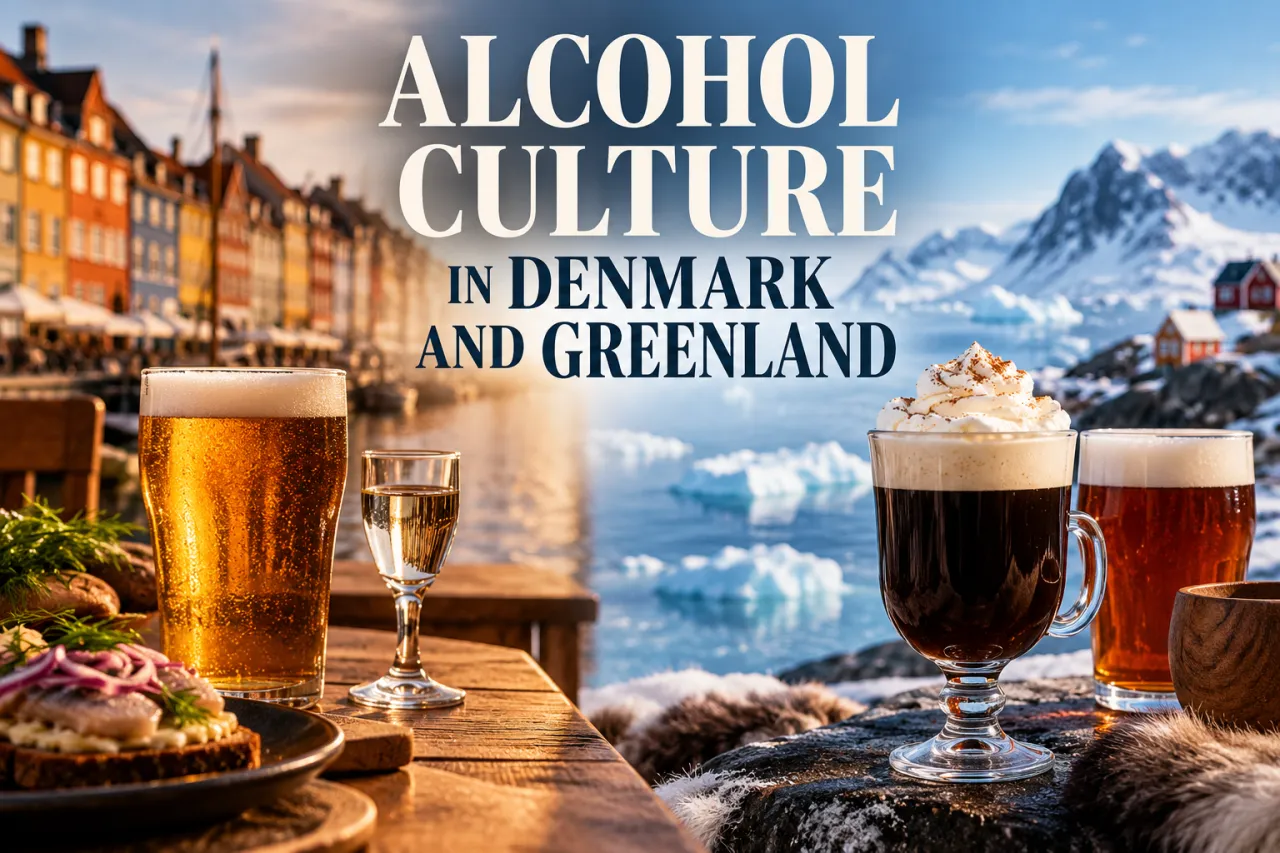
Traditional Danish food culture frequently pairs beer with snaps, a small serving of aquavit or another flavored spirit. It's particularly associated with foods such as pickled herring and smørrebrød, and with long holiday lunches around Christmas and Easter.
Then there's the bodega, Denmark's old-school answer to the neighborhood pub. These tend to be informal places built around beer, conversation, games, and regular customers rather than elaborate cocktail programs.
Alcohol can certainly appear in a hygge setting, but it's worth keeping the terms separate. Hygge is a much broader idea of comfortable, convivial time with other people. A glass of wine or beer might be part of it, but alcohol isn't what makes something hygge.
Denmark's alcohol rules changed in 2025
Denmark historically had unusually permissive retail rules for young people compared with several neighboring countries, but those rules became stricter on April 1, 2025.
For retail sales today:
| Alcohol strength | Minimum age |
|---|---|
| More than 1.2% through 6% ABV | 16 |
| More than 6% ABV | 18 |
That means a 16- or 17-year-old can still legally buy an ordinary-strength beer in a shop, but not wine, spirits, shots, or other drinks above 6% ABV.
Danish health guidance is stricter than the legal purchasing rules. The Danish Health Authority advises people under 18 not to drink alcohol. For adults, it recommends no more than 10 standard Danish drinks per week and no more than four on the same day.
Denmark's 2025 National Health Profile found that 14.4% of adults reported drinking more than 10 drinks during a typical week, down from 24.6% in 2010.
So while alcohol remains highly visible in Danish social life, the longer-term story isn't simply that "Danes drink a lot." The proportion drinking above the national weekly recommendation has fallen substantially.
Greenland's alcohol history followed a different path
Greenland's relationship with alcohol can't be understood by simply comparing today's consumption figure with Denmark's.
Access, regulation, rapid social change, public health, and alcohol's effects on families and communities have all played roles in Greenland's alcohol-policy debate.
One particularly important period began in the late 1970s.
After a 1978 referendum, Greenland introduced a nationwide alcohol rationing system in 1979. Adults received a monthly allocation of alcohol points that limited how much they could purchase.
Recorded alcohol consumption fell while the restrictions were in effect, but the system also produced unintended consequences, including a market for trading ration points. Nationwide rationing was abolished in 1982, although local restrictions continued in some areas.
Alcohol consumption subsequently rose sharply. Research tracing Greenland's alcohol supply over time places the peak at roughly 22 litres of pure alcohol per person aged 15 and older in 1987.
What happened afterward is just as important: consumption declined substantially.
How much alcohol is supplied in Greenland today?
Statistics Greenland tracks alcohol through imports and domestic production rather than asking individuals to remember exactly what they drank.
In 2025, the recorded supply was equivalent to 8.3 litres of pure alcohol per person over age 14, up slightly from 8.1 litres in 2024.
Beer accounted for most of it. Statistics Greenland recorded 6.35 litres of pure alcohol per person from beer, compared with 1.19 litres from wine and 0.74 litres from spirits.
Those figures shouldn't be placed directly beside Danish survey statistics and treated like a scoreboard. They're measuring different things.
Denmark's National Health Profile asks people about their drinking behavior. Greenland's alcohol statistics primarily measure alcohol entering the market through imports and domestic production.
The useful takeaway is the trend: Greenland's current alcohol supply is dramatically below the levels seen at the 1980s peak, even though alcohol-related harm remains an important public-health concern.
Greenland is still changing its approach to alcohol policy
Greenland has also been reconsidering how alcohol should be regulated.
The Government of Greenland has worked with the Centre for Public Health in Greenland and WHO/Europe on recommendations for a long-term national alcohol policy, with particular attention to the effects of alcohol on children and young people.
The process has considered structural measures involving alcohol availability, pricing, marketing, prevention, treatment, and age restrictions rather than treating alcohol-related harm solely as a matter of individual choices.
That distinction matters. Policy recommendations and proposals aren't the same thing as laws already in force.
Under Greenland's current alcohol law, alcohol may not be sold or served to anyone under 18.
The broader policy discussion reflects an attempt to address alcohol through several routes at once: availability, enforcement, prevention, treatment, and the effects of adult drinking on families and children. WHO/Europe has been involved in that policy-development process.
Greenlandic social culture isn't defined by alcohol
An article about alcohol culture can easily give the false impression that drinking is the defining feature of social life. Greenland offers a particularly good reason not to make that mistake.
Kaffemik is a Greenlandic social tradition centered on visiting, coffee, food, and hospitality. It can mark birthdays, weddings, confirmations, first days of school, and other occasions, with guests coming and going rather than necessarily sitting through one formal event.
Coffee is quite literally central to the idea.
That matters because Greenland's beverage culture includes both alcoholic and non-alcoholic traditions. Talking only about alcohol statistics leaves out an important part of how people actually gather.
Greenlandic Coffee is the drink worth knowing
There is, however, one alcoholic coffee drink closely associated with Greenland: Greenlandic Coffee.
Visit Greenland describes versions of the hot cocktail being served in establishments along the coast. Recipes vary, but the familiar combination uses whisky, coffee liqueur, orange liqueur, hot coffee, and whipped cream.
Boozeopedia's Greenlandic Coffee recipe uses Scotch, Kahlúa, Grand Marnier, black coffee, sugar, and whipped cream. The Grand Marnier can be warmed and ignited before being poured over the cream, although the flame is entirely optional.
If you're making it at home, the non-flaming version gives you the same basic combination of coffee, spirits, orange, and cream with a lot less fuss.
For more practical advice on balancing spirits, sweetness, cream, and coffee, our guide to making better coffee cocktails covers the fundamentals.
Two places, two different alcohol stories
Denmark and Greenland make an interesting comparison precisely because the simple version doesn't hold up.
Denmark has deeply established beer, snaps, bodega, and holiday-drinking traditions alongside declining rates of drinking above national recommendations and recently tightened youth sales rules.
Greenland has experienced much sharper historical swings in alcohol availability and consumption. Today's supply is far below its 1980s peak, while alcohol policy remains an active public-health issue.
And in both places, beverage culture is bigger than alcohol alone. A Danish lunch doesn't require snaps to be Danish, and a Greenlandic kaffemik doesn't need a flaming cocktail to be a kaffemik.
The drinks are part of the story. They're not the whole story.