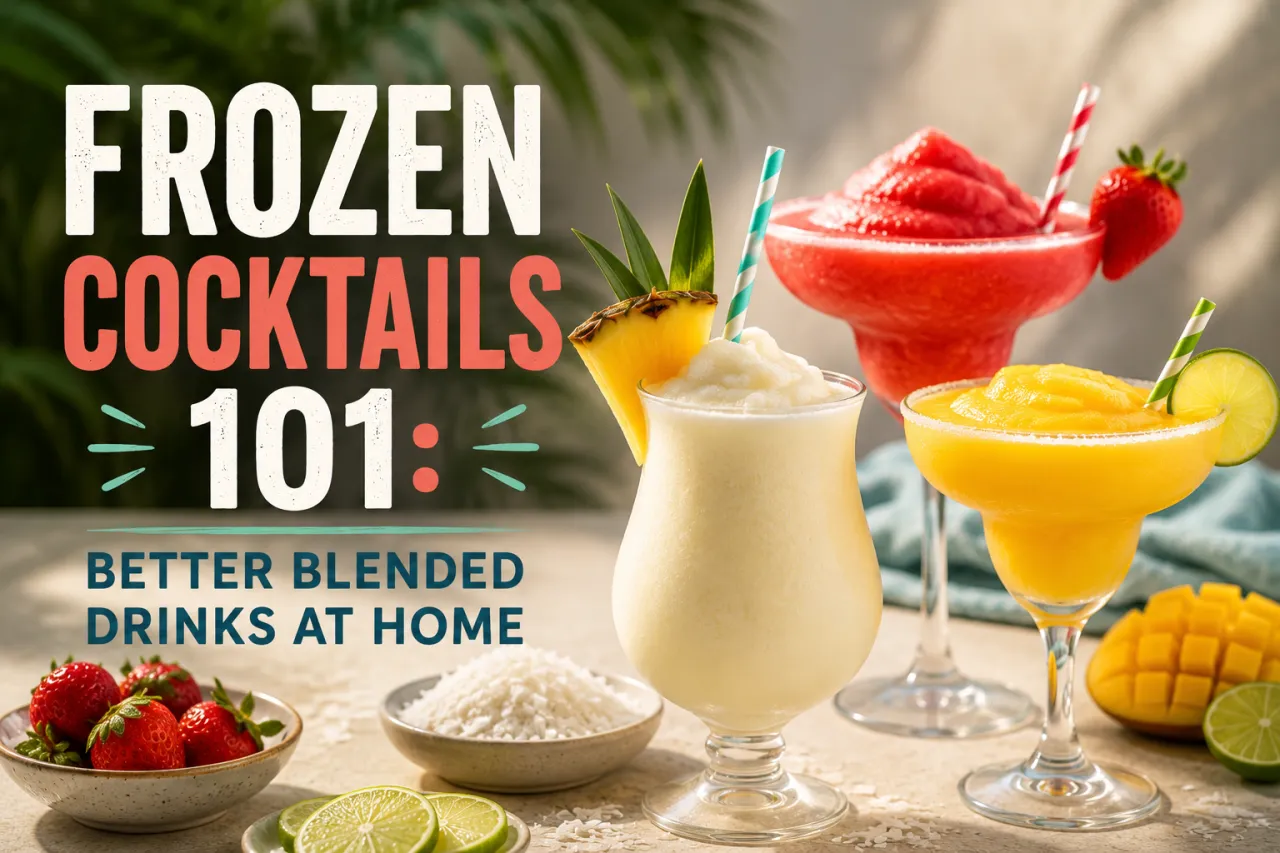
Frozen Cocktails 101: Better Blended Drinks at Home
By Dave C & Boozeopedia AI Workflow
See how we write our articles
Updated September 2026. This article was originally published in July 2025 and has been refreshed with updated recipes, better blender advice, and practical troubleshooting tips.
Frozen cocktails have one obvious advantage in hot weather: they’re very cold.
The catch is that throwing a normal cocktail and a pile of ice into a blender doesn’t automatically make a good one. Too much ice and the flavor disappears. Too little and you get cold cocktail soup. Add too much alcohol and the texture gets even harder to manage.
Fortunately, you don’t need a commercial frozen-drink machine or an expensive blender to improve things.
A decent blender, cold ingredients, the right amount of ice, and a willingness to adjust as you go will get you most of the way there.
What Makes a Frozen Cocktail Work?
A frozen cocktail has to balance the same things as any other drink: spirit, acidity, sweetness, flavor, and dilution.
The difference is that ice isn’t just chilling the drink. It becomes part of its texture.
That’s why there isn’t one magic ice-to-liquid ratio that works for every frozen cocktail.
A Frozen Margarita made with tequila, lime, and syrup behaves differently from a Piña Colada containing coconut cream and pineapple juice. A Banana Daiquiri gets body from actual fruit. Frosé starts with partially frozen wine.
Treat the recipe as a starting point rather than assuming every blender needs the same number of ice cubes.
Start With Cold Ingredients
The warmer everything is when it enters the blender, the more ice has to melt before the drink gets properly cold.
That extra melted ice becomes extra water.
Chill your juice, wine, mixers, and spirits when practical. You don’t need to keep every bottle in the freezer, but starting with refrigerator-cold ingredients gives you more control.
Chilling the serving glass helps too, although it won’t rescue a badly blended drink.
Crushed Ice Helps, but Cubes Aren’t a Dealbreaker
Crushed ice is easier for a blender to process quickly and evenly. Several Boozeopedia frozen recipes specifically call for it.
But ordinary ice cubes can still work.
If your blender struggles, pulse the cubes briefly before adding the other ingredients, or crush the ice in smaller batches.
What you don’t want to do is keep adding liquid simply because the blades stop moving. That fixes the blender problem by creating a drink problem.
Add only a small splash when necessary.
Frozen Fruit Is Doing More Than Adding Flavor
Frozen strawberries, mango, pineapple, or banana can give a drink body while reducing how much plain ice you need.
That usually means more fruit flavor and less dilution.
It’s especially useful in drinks like a frozen Daiquiri, where too much ice can quickly bury the rum and lime.
Fresh fruit still works, but you may need more ice to reach the same texture.
Five Frozen Cocktails Worth Knowing
You could turn almost anything into a blender experiment. These five are better places to start.
Frozen Margarita
The Frozen Margarita is the obvious benchmark.
Boozeopedia’s recipe blends tequila blanco, triple sec, fresh lime juice, simple syrup, and ice.
It’s a good drink for learning frozen balance because there’s nowhere for mistakes to hide. Too much ice and the tequila and lime disappear. Too much syrup and it tastes heavy. Too much liquid and you lose the slushy texture.
Start with the recipe, blend until smooth, and stop.
Blending for an extra minute because it looks fun mostly gives the ice more time to melt.
If you want to add fruit, frozen strawberries or mango are easier to manage than pouring in more juice.
Piña Colada
The Piña Colada approaches frozen texture very differently.
Light rum, coconut cream, and pineapple juice already have considerably more body than a Margarita. The coconut component gives the drink richness, so the goal is smooth and frosty rather than aggressively icy.
This is also one of those cocktails where understanding your coconut ingredient matters.
Coconut cream and cream of coconut aren’t identical. Cream of coconut is typically sweeter, so substituting it can change the balance. If that’s what you have, taste before assuming the drink needs additional sweetness.
Frozen pineapple is a useful addition if you want more fruit flavor and body.
Frozen Banana Daiquiri
The Frozen Banana Daiquiri combines light rum, banana, lime, banana liqueur, simple syrup, and crushed ice.
A ripe banana does a lot of the texture work here.
That means you don’t need to chase thickness by endlessly adding ice. The fruit gives the drink a naturally fuller body while lime keeps the banana and liqueur from becoming too sweet.
If the blender stalls, the Boozeopedia recipe recommends adding only a very small splash of water.
That “very small” part matters.
You can always loosen a frozen drink. Turning a watery one back into a balanced cocktail is harder.
Frozen Aperol Spritz
The Frozen Aperol Spritz is a useful reminder that frozen drinks don’t all need to be heavy.
Aperol, Prosecco, orange juice, soda water, and ice give it the bittersweet citrus character of a Spritz in slushy form.
There is a tradeoff: putting sparkling ingredients in a blender knocks out much of their carbonation.
You’re choosing texture over bubbles.
That’s not necessarily a problem, but it helps to know what you’re making. If you want the snap and fizz of a traditional Spritz, make a regular one. If the temperature outside is making a blender seem like the better idea, this version has its place.
Frosé
Frosé takes another approach entirely.
Instead of relying primarily on ice, Boozeopedia’s version starts by freezing dry rosé until it becomes thick and slushy. That frozen wine is then blended with frozen strawberries, lemon juice, and simple syrup, with additional ice only if needed.
That’s a smart way to preserve flavor.
If you made the same drink by pouring room-temperature rosé over a mountain of ice, you’d need much more dilution to get it frozen.
Use a dry rosé rather than a sweet one. Once strawberries and syrup join the blender, you already have plenty of control over sweetness.
How to Fix a Frozen Cocktail That’s Too Thin
First, stop blending.
The longer the blender runs, the more heat it creates and the more ice melts.
Then add a modest amount of crushed ice or frozen fruit and pulse briefly.
If the drink is already watery because too much ice has melted, piling in enormous amounts of fresh ice may restore the texture but leave the flavor washed out.
At that point, you may also need a small adjustment of the drink’s flavorful ingredients.
The better solution is prevention: cold ingredients, enough ice from the beginning, and a short blend.
What if It’s Too Thick?
A frozen cocktail shouldn’t require excavation equipment.
If the mixture sits above the blades and refuses to circulate, turn the blender off before doing anything else.
Add a very small amount of liquid and try again.
What liquid depends on the drink. Pineapple juice may make sense in a Piña Colada. A tiny splash of water can loosen a Banana Daiquiri without changing its flavor much. In some recipes, a little extra citrus or mixer may work.
Add less than you think you need.
You can always add another splash.
Taste Frozen Drinks Before Serving Them
Very cold temperatures can make sweetness and aroma seem less obvious, which is one reason frozen drinks sometimes need slightly different balance than their shaken counterparts.
But don’t automatically dump in extra syrup.
Taste first.
If the drink seems dull, it may need citrus rather than sugar. If it’s sharply tart, then sweetness may be the answer.
And if it just tastes watery, syrup isn’t going to put the tequila or rum back.
Adjust the actual problem.
Don't Overload the Blender
A recipe that makes one or two drinks doesn’t automatically become a six-drink batch because you multiplied everything by three and forced the lid closed.
Blenders need room for ingredients to circulate.
For a party, blend in manageable batches. The texture will be better, and your blender will have a less traumatic afternoon.
You can pre-measure non-frozen ingredients to make each batch faster.
Frosé is particularly useful for groups because the wine can be partially frozen ahead of time.
Serve Frozen Drinks Immediately
There’s no clever technique that changes this part.
Frozen cocktails melt.
Pour them as soon as they’re blended. A chilled glass slows things slightly, but this is not a Martini you can leave sitting on the counter while you find the perfect garnish.
For parties, make smaller batches more often rather than one enormous batch that spends 45 minutes turning into punch.
You Probably Don't Need the Fancy Garnish
A lime wheel on a Margarita, pineapple on a Piña Colada, or strawberry with Frosé makes sense.
After that, garnish according to how much effort you feel like making.
Frozen drinks already have plenty of visual appeal. They don’t need three fruit skewers, an orchid, an umbrella, a flaming lime shell, and half the contents of the produce drawer balanced on top.
Especially if the garnish makes the drink harder to drink.
Start With a Recipe, Then Learn to Adjust
The easiest way to get better at frozen cocktails is to make a good recipe first.
Once you know roughly how a Frozen Margarita or Piña Colada should behave in your blender, experimentation becomes much easier. You’ll start recognizing whether the next batch needs more ice, less liquid, additional acidity, or simply five fewer seconds of blending.
If you’re planning a broader summer menu rather than an afternoon dedicated to the blender, our summer cocktails and mocktails guide has plenty of drinks that don’t require plugging anything in.
Frozen cocktails should be fun.
The blender already makes enough noise without you stressing about them.