Lime Cocktails & Mocktails: 7 Drinks Worth Making
By Dave C & Boozeopedia AI Workflow
See how we write our articles
Updated September 2026. This article was originally published in August 2025 and has been refreshed with verified Boozeopedia recipes, corrected links, and a more practical look at how lime works in drinks.
Lime shows up in an enormous number of cocktails, but it doesn't always do the same job. In a Daiquiri, it provides most of the drink's acidity. In a Mojito, it has to work alongside mint, sugar, rum, and soda. In a Caipirinha, the peel matters too, because muddling the fruit releases aromatic citrus oils as well as juice.
That makes lime more useful than simply calling it "zesty" and moving on.
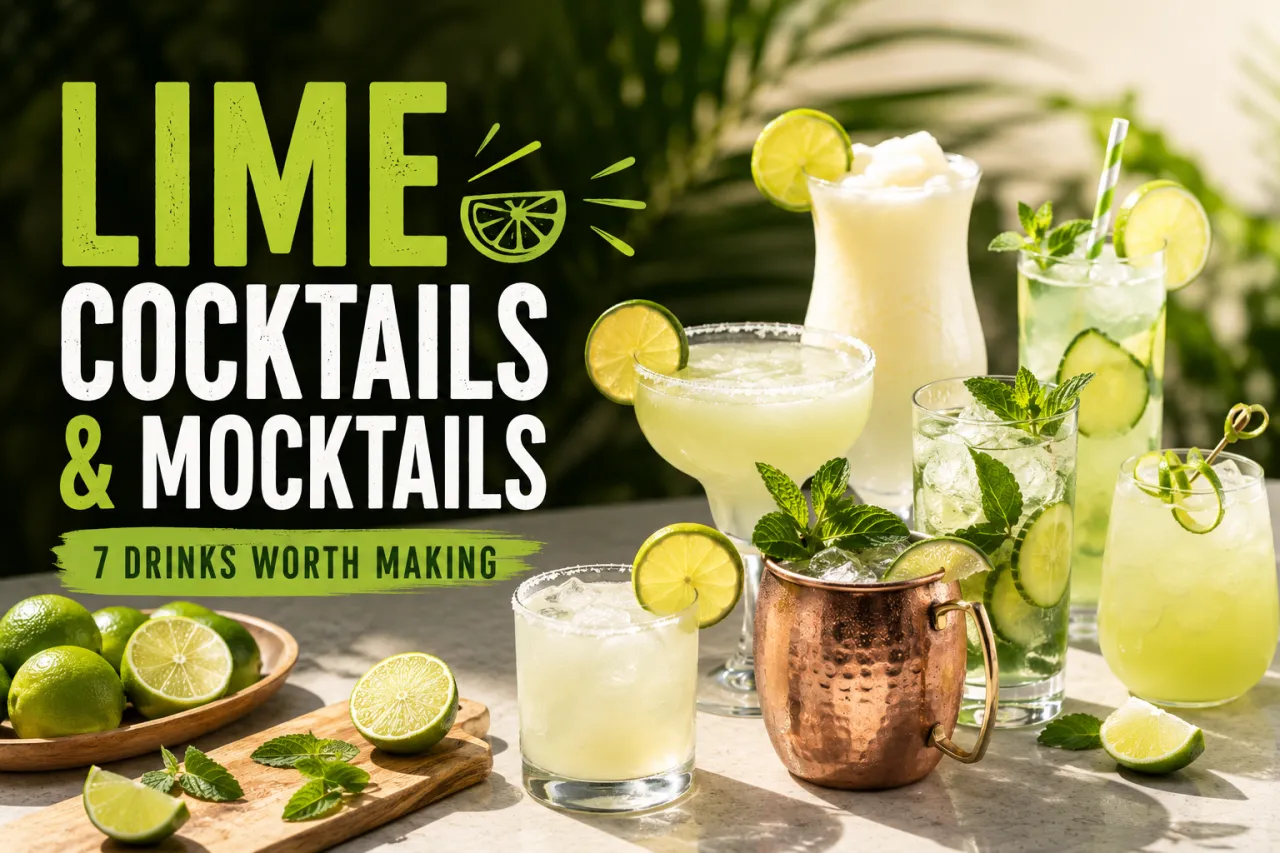
These seven lime cocktails and mocktails show several different ways to put the fruit to work, from stripped-down sours to tall, fizzy drinks. If you want the deeper dive on squeezing, storing, measuring, and working with citrus behind the bar, see our guide to fresh juice for cocktails.
What Lime Brings to a Drink
Most often, lime juice supplies acidity. That tartness balances sugar, fruit juice, liqueurs, and sweeter spirits while making other flavors taste more distinct.
But the form matters. Fresh juice contributes clean acidity and citrus aroma. A muddled lime wedge also brings oils from the peel. A lime wheel on the rim mostly contributes aroma and presentation rather than changing the balance of the drink itself.
That difference becomes pretty obvious when you compare the drinks below.
Margarita: Lime Against Tequila and Orange
The classic Margarita is one of the clearest examples of lime doing structural work.
Boozeopedia's recipe combines blanco tequila with lime juice and triple sec. The orange liqueur brings sweetness as well as another layer of citrus, while lime provides the sharper acidity that keeps the cocktail from becoming soft or syrupy. A salt rim adds another contrast, but the lime is what holds the liquid portion together.
It's a good choice when you want a lime drink where the citrus is obvious without completely covering the base spirit.
And while a lot of Margarita variations pile on fruit, spice, syrups, or blended ice, the classic is useful precisely because there's nowhere for bad balance to hide.
Daiquiri: The Simplest Lime Test
A classic Daiquiri cuts things down even further: light rum, lime juice, and simple syrup.
That short ingredient list makes it an excellent demonstration of sweet-and-sour balance. Too little lime and the drink feels sugary. Too much and it becomes aggressively tart. When the proportions are right, the citrus gives the rum definition rather than simply making the drink taste like lime.
This is also why the classic Daiquiri deserves to be separated mentally from the oversized frozen fruit drinks that sometimes share its name. Boozeopedia's version is shaken and served up in a chilled coupe, with no blender required.
If you're learning how lime behaves in cocktails, this is one of the best places to start.
Gimlet: Lime Meets Gin Botanicals
The Gimlet uses the same broad spirit-citrus-sweetener idea, but gin changes the equation.
Boozeopedia's recipe combines gin, lime juice, and simple syrup. Where rum in a Daiquiri tends to give lime a relatively clean backdrop, gin brings juniper and other botanical flavors into the mix. The lime needs enough presence to keep the drink crisp without flattening those aromatics.
The result is sharper and more herbal than a Daiquiri even though the basic structure looks similar on paper.
This is a useful reminder that swapping the spirit in a three-ingredient sour doesn't just change the alcohol. It changes what the citrus has to balance.
Caipirinha: When the Lime Peel Matters Too
The Caipirinha handles lime differently from every shaken drink above.
Instead of measuring lime juice into a shaker, Boozeopedia's recipe uses a whole lime cut into small wedges. The fruit is gently muddled with sugar before cachaça and cracked ice are added.
That means you're getting juice plus aromatic oils from the peel. It gives the drink a more rustic, intensely lime-forward character than you would get by simply pouring bottled or strained juice into the glass.
"Gently" is doing important work here. You want to press the fruit enough to release its juice and aroma, not pulverize the peel until bitterness takes over.
The Caipirinha is the drink to make when you want to understand the difference between using lime juice and actually working with the whole fruit.
Mojito: Lime Needs Mint and Bubbles to Cooperate
A Mojito asks lime to share the stage.
Boozeopedia's version combines light rum, lime juice, sugar, mint, and club soda. The citrus supplies the tart backbone, mint adds a strong aromatic layer, and soda lengthens the drink without adding more sweetness.
The important part is restraint. The mint is gently muddled rather than shredded, and the soda goes in near the end so the carbonation survives. Lime should still be clearly present, but the finished drink shouldn't taste like sour lime soda with some battered mint floating around in it.
Compared with the Daiquiri, this is a looser, taller style of drink. The same rum-and-lime pairing behaves very differently once herbs, bubbles, and additional dilution enter the picture.
Nojito: A Lime-and-Mint Mocktail With Real Structure
Removing the rum from a Mojito leaves a bigger hole than the name "Nojito" might suggest. Alcohol contributes body as well as flavor, so an alcohol-free version still needs enough acidity, sweetness, dilution, and aroma to feel complete.
Boozeopedia's Nojito uses lime juice, mint, simple syrup, and soda water. It leans into the same mint-and-citrus combination as a Mojito but adjusts the other ingredients around the missing spirit.
It's a straightforward zero-proof option if what you actually like about a Mojito is the mint, lime, ice, and fizz rather than the rum.
As with the cocktail version, don't attack the mint with the muddler. Bruised leaves smell good. Green confetti mostly gives you something to pick out of your teeth.
Cucumber Lime Fizz: Lime as the Backbone of a Mocktail
For a mocktail that isn't simply an alcohol-free version of a famous cocktail, try the Cucumber Lime Fizz.
It combines cucumber, lime juice, simple syrup, club soda, and a small pinch of salt. Here, cucumber gives the drink a fresh vegetal note but very little acidity of its own, so lime provides most of the structure. Simple syrup rounds it out, while soda keeps the finished drink light.
That tiny pinch of salt is also useful. It isn't there to make the drink taste salty. It helps give a very simple cucumber-and-citrus mixture a little more definition.
This is a good template to remember when improvising alcohol-free drinks: fruit or vegetables for flavor, citrus for acidity, enough sweetener for balance, then bubbles to lengthen the whole thing.
Which Lime Drink Should You Make?
If you want lime front and center, start with a Daiquiri or Gimlet. Both have short ingredient lists, so the citrus is easy to taste and adjust.
Choose a Margarita when you want tequila and orange alongside the lime, or a Caipirinha when you want the stronger aroma and character that come from muddling the whole fruit.
For something taller, the Mojito brings mint and carbonation into the picture. The Nojito follows a similar direction without alcohol, while the Cucumber Lime Fizz shows how lime can provide structure to a mocktail that stands on its own.
You don't need to make lime complicated. You just need to decide what job you want it to do.