Campari vs. Aperol: What’s the Difference?
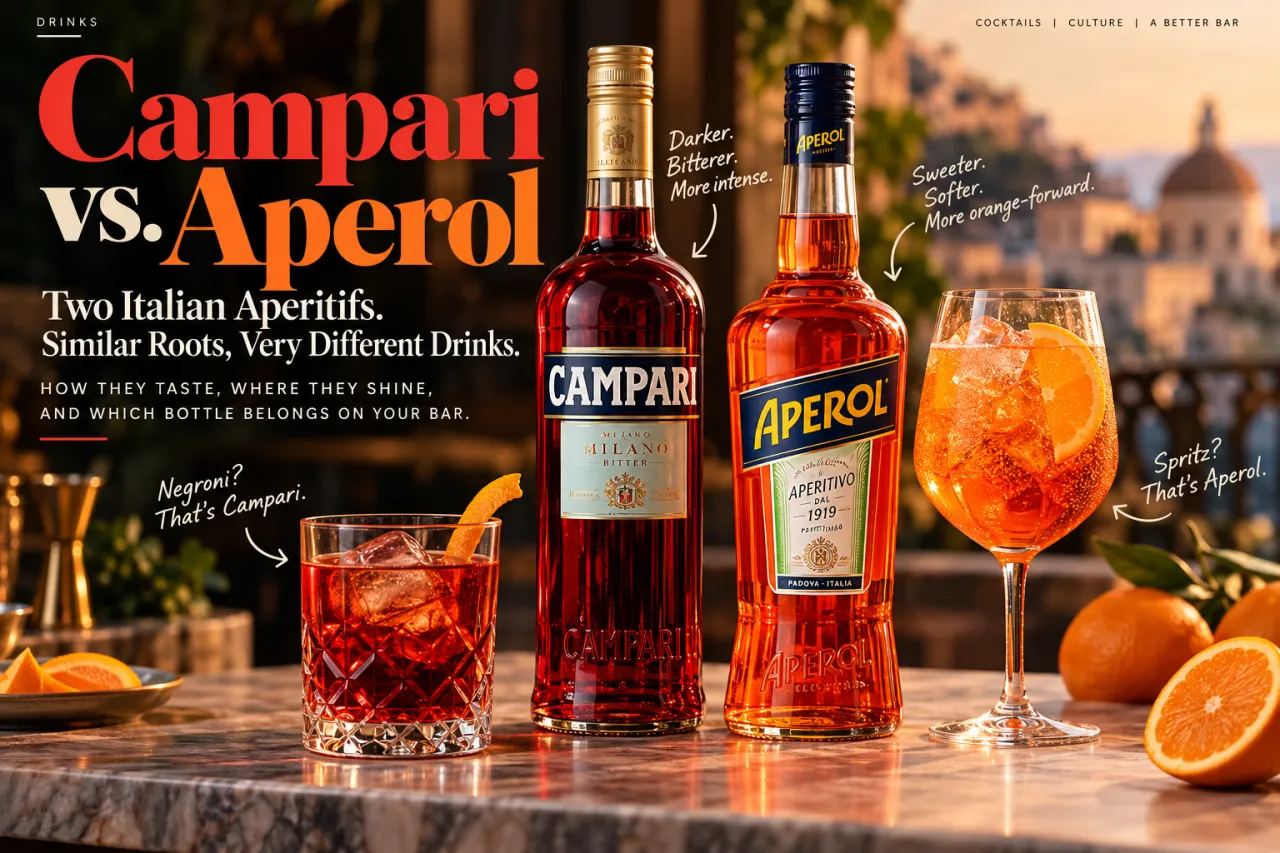
Campari and Aperol often sit next to each other behind the bar. Both are colorful Italian aperitifs, both bring citrus and herbal bitterness to cocktails, and both are closely associated with pre-dinner drinking.
Pour them side by side, though, and the difference is obvious.
Campari is darker, more bitter, more intense, and higher in alcohol. Aperol is sweeter, softer, more orange-forward, and lower in alcohol.
That distinction matters whether you're choosing between a Negroni and a Spritz or simply wondering if the bottle you already own can replace the one a recipe calls for.
Campari vs. Aperol at a Glance
| Campari | Aperol | |
|---|---|---|
| Style | Italian bitter aperitif | Italian bitter aperitif |
| Color | Deep red | Bright orange |
| Flavor | Assertively bitter, herbal, citrusy | Sweeter, softer, orange-forward |
| Bitterness | High | Moderate |
| Alcohol | Higher; strength varies by market | 11% ABV in many markets |
| Best known for | Negroni, Americano, Boulevardier | Aperol Spritz |
| Pairs especially well with | Gin, whiskey, sweet vermouth, orange, pineapple | Sparkling wine, citrus, bourbon, mezcal |
| What it adds to a cocktail | Pronounced bitterness and structure | Gentle bitterness, citrus, and sweetness |
They're similar in purpose, but they're not interchangeable without changing the drink.
What Is Campari?
Campari is an Italian bitter aperitif created in the 19th century. Its exact formula is proprietary, but its defining character is easy to recognize: pronounced bitterness backed by orange, herbs, and other botanical flavors.
The bitterness isn't just a background note. In many cocktails, it's one of the main structural ingredients.
The classic example is the Negroni, which combines equal parts gin, Campari, and sweet vermouth. Gin brings dry botanical character, vermouth contributes sweetness and herbs, and Campari supplies the bitter edge that prevents the drink from becoming soft or overly sweet.
That same intensity allows Campari to stand up to whiskey in a Boulevardier and to sweeter tropical ingredients in drinks such as the Jungle Bird.
If you already enjoy flavors such as grapefruit peel, bitter orange, tonic water, or strongly herbal liqueurs, Campari's assertiveness may feel familiar.
What Is Aperol?
Aperol was created in Padua in 1919 and occupies similar aperitivo territory, but its personality is considerably gentler.
Aperol is distinctly bittersweet, with noticeable orange and herbal flavors, but it doesn't have Campari's concentrated bitter finish. It's also substantially lower in alcohol.
Its best-known use is the Aperol Spritz, where Aperol is combined with Prosecco and soda water. Sparkling wine provides fruit and carbonation, while soda stretches everything into a long, refreshing aperitif.
Aperol isn't limited to spritzes.
The Paper Plane, for example, combines bourbon, Aperol, amaro, and lemon juice in equal parts. Aperol provides bitterness and orange flavor without overwhelming the whiskey, herbal amaro, or fresh citrus.
That's an important distinction: Aperol isn't merely a weaker Campari. Its softer profile can be useful when a cocktail already contains several assertive ingredients.
Does Campari Taste Like Aperol?
There is a family resemblance, but you probably wouldn't confuse them side by side.
Aperol tends to lead with sweet orange and gentle herbal bitterness. Its sweetness is easier to notice, and the finish is relatively soft.
Campari is more intensely bitter and herbal, with citrus sitting alongside those darker botanical flavors. Its finish is longer, drier, and considerably more assertive.
A useful shorthand is:
- Aperol: citrus first, bitterness second
- Campari: bitterness first, citrus and herbs behind it
That's not a technical classification, but it's a useful way to decide what a cocktail needs.
Is Campari Stronger Than Aperol?
Yes.
Aperol is generally bottled at 11% ABV, while Campari is considerably stronger. Campari's exact alcohol content varies by market.
That doesn't mean every Campari cocktail will contain more alcohol than every Aperol cocktail. The full recipe still matters. A drink containing Aperol alongside bourbon or mezcal can be plenty strong.
But when you replace Aperol with an equal amount of Campari, you're generally adding both more alcohol and more bitterness.
You'll notice that especially in a spritz, where the aperitif makes up a substantial part of the finished drink.
Can You Substitute Campari for Aperol?
Yes, but expect the cocktail to change.
Replacing Aperol with Campari generally makes a drink:
- more bitter
- less sweet
- more herbal
- darker in color
- higher in alcohol
Replacing Campari with Aperol moves things in the opposite direction. The cocktail becomes softer, sweeter, more citrus-forward, and less bitter.
For home experimentation, starting with a one-for-one swap is reasonable. Taste the finished drink before changing anything else.
If the balance seems off, adjust from there. A Campari version may benefit from a little more sweetness or dilution, while an Aperol version may need less sweetener elsewhere in the recipe.
What Happens If You Put Aperol in a Negroni?
You'll still have a combination of gin, vermouth, citrus, and bitter aperitif, but it won't taste like the standard Negroni.
Aperol makes the drink softer, sweeter, and less bitter. Gin and vermouth become more prominent because Aperol doesn't push against them as forcefully as Campari.
If you like the general idea of a Negroni but find the classic aggressively bitter, it's an easy variation to try. Just think of it as a riff rather than a direct substitute for the original.
Can You Make a Spritz With Campari?
Absolutely.
Campari, sparkling wine, and soda follow the same general spritz format, but the result is more bitter and assertive than an Aperol Spritz.
It's also one of the easiest ways to understand the difference between the two bottles because the rest of the drink can remain almost unchanged.
If you enjoy an Aperol Spritz but want more bitterness, Campari is a logical next step.
When Should You Use Campari?
Choose Campari when you want bitterness to be an important part of the cocktail rather than a subtle accent.
It works particularly well in:
- Spirit-forward cocktails: Gin, bourbon, rye, and other assertive base spirits can stand up to Campari.
- Vermouth drinks: Sweet vermouth is especially effective at balancing Campari's bitterness.
- Tropical cocktails: Pineapple and other sweet fruit can handle more bitterness than you might expect.
- Simple highballs: Soda or citrus can lengthen Campari without hiding its character.
The Negroni is the obvious starting point, but Campari and soda is an even simpler way to learn what the ingredient tastes like on its own.
When Should You Use Aperol?
Choose Aperol when you want bitterness without making it the main event.
It works especially well in:
- Spritzes: Sparkling wine and soda keep its citrus character bright and refreshing.
- Sours: Lemon and lime naturally complement its orange-forward profile.
- Whiskey cocktails: Aperol can provide bitterness without burying bourbon's oak and caramel notes.
- Mezcal drinks: Its sweetness and citrus can soften smoky, earthy flavors.
- Lower-alcohol cocktails: Its relatively low strength makes it useful in lighter aperitivo-style drinks.
Don't think of Aperol simply as "Campari for people who don't like bitter drinks."
Cocktails such as the Paper Plane use Aperol because its particular balance of citrus, sweetness, and bitterness fits the other ingredients.
Campari or Aperol: Which Should You Buy?
If you mainly want to make Negronis, Boulevardiers, Americanos, or bitter spirit-forward cocktails, Campari is the more useful bottle.
If you're mostly interested in spritzes, lighter aperitivo drinks, or cocktails with a gentler bitter-orange character, Aperol will probably get more use.
For a well-rounded home bar, having both makes sense because they solve different problems.
Campari provides concentrated bitterness and structure. Aperol contributes softer bittersweet citrus.
They may occupy neighboring spots on the bar shelf, but they're not two versions of the same ingredient. Once you've tried both in a couple of cocktails, the difference becomes pretty hard to miss.