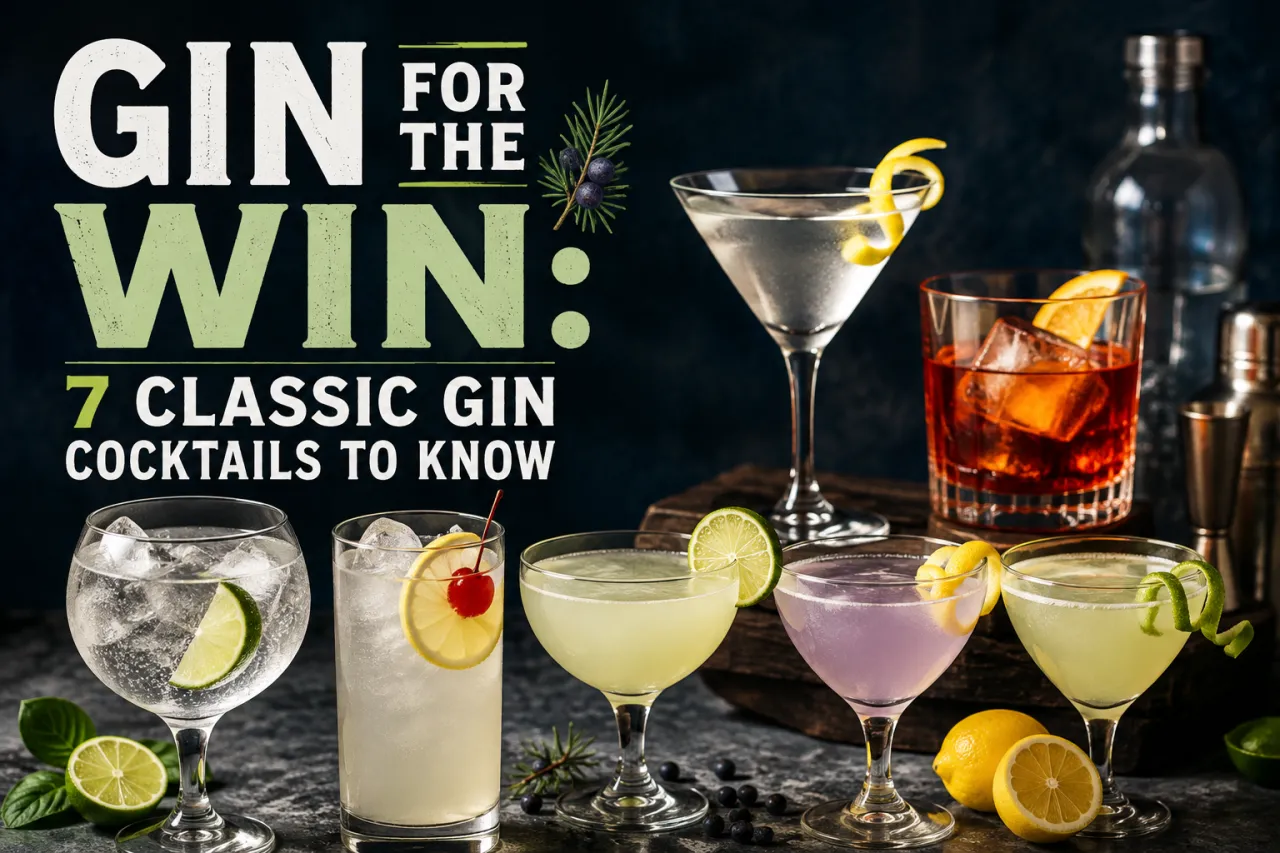
Gin for the Win: 7 Classic Gin Cocktails to Know
By Dave C & Boozeopedia AI Workflow
See how we write our articles
Originally published October 2024. Updated August 2026 with refreshed recipe guidance, practical mixing tips, and revised historical context.
Gin can go in remarkably different directions without losing its identity. Stir it with dry vermouth and you get a crisp Martini. Shake it with lime and sugar and it becomes a bright Gimlet. Pair it with Campari and sweet vermouth and you have the bitter, herbal backbone of a Negroni.
That range comes from gin's botanical character. Juniper provides the defining flavor, while citrus peel, roots, herbs, spices, flowers, and other botanicals can make one gin taste noticeably different from another.
If you're building a home bar or simply figuring out which gin drinks you actually like, these seven classic gin cocktails are a useful place to start.
7 Classic Gin Cocktails at a Glance
- Martini: dry, cold, and spirit-forward
- Negroni: bitter, herbal, and bittersweet
- Gin and Tonic: crisp, bubbly, and refreshing
- Tom Collins: citrusy, lightly sweet, and fizzy
- Gimlet: tart, compact, and lime-forward
- Aviation: floral, citrusy, and delicate
- The Last Word: herbal, tart, and intensely layered
There isn't one "best" gin cocktail. The right starting point depends on whether you want something refreshing, bitter, sour, floral, or unapologetically boozy.
1. Martini
Try it if you like: dry, spirit-forward cocktails.
The Martini is gin with nowhere to hide, which is exactly why small choices make such a noticeable difference.
Boozeopedia's classic Martini recipe uses 2 1/2 ounces of gin and 1/2 ounce of dry vermouth. The drink is stirred with ice, strained into a chilled Martini glass, and finished with either a lemon twist or olives.
A juniper-forward gin makes the drink sharper and more traditional, while a softer or more citrus-driven gin shifts the emphasis toward those botanicals. Vermouth matters just as much. Because dry vermouth is wine-based, keep an opened bottle refrigerated rather than treating it like a shelf-stable spirit.
If you're new to Martinis, start with the recipe as written before chasing ultra-dry versions. Vermouth isn't filler. It contributes aroma, herbal complexity, and balance.
2. Negroni
Try it if you like: bitterness, orange, herbs, and slow sipping.
The Negroni has one of the easiest formulas in classic cocktails: equal parts gin, Campari, and sweet vermouth.
The Boozeopedia Negroni uses 1 ounce of each ingredient. It's stirred until chilled, strained over a large ice cube, and finished with an expressed orange peel.
Gin supplies the dry botanical structure, Campari brings assertive bitter-orange flavor, and sweet vermouth rounds everything out with sweetness, herbs, and spice.
The drink is commonly associated with Florence around 1919, although cocktail origin stories are rarely as tidy as the familiar retellings suggest. More important for the person actually drinking one: a Negroni is supposed to taste bitter. It isn't a sweet orange cocktail.
If you're trying one for the first time, give the drink a few sips as the ice begins to dilute it. A little water and temperature change can soften the edges considerably.
3. Gin and Tonic
Try it if you like: crisp, bubbly drinks with minimal fuss.
A Gin and Tonic is simple enough to make almost anywhere, but that simplicity means every ingredient is easy to taste.
Our Gin and Tonic recipe uses 2 ounces of gin and 4 ounces of tonic water over ice, with a lime wedge to finish.
Tonic water brings carbonation, sweetness, and the distinctive bitterness of quinine. Because it makes up most of the finished drink, changing tonic brands can alter the flavor considerably. A bold tonic may suit a juniper-heavy gin but overpower something softer and more floral.
Keep the tonic cold and pour it gently to preserve the carbonation. A brief stir is enough.
Lime is the straightforward garnish, but lemon peel, cucumber, or a restrained herb garnish can also work when it complements botanicals already present in the gin. The goal is to support the drink, not turn the glass into a garden center.
4. Tom Collins
Try it if you like: lemonade, citrus, and refreshing highballs.
The Tom Collins is essentially a gin sour lengthened with sparkling water, which makes it one of the easiest classic gin cocktails to enjoy on a warm day.
Boozeopedia's Tom Collins recipe combines 2 ounces of gin, 1 ounce of lemon juice, and 1/2 ounce of simple syrup. Those ingredients are shaken briefly, strained over ice, topped with carbonated water, and garnished with lemon and a maraschino cherry.
Unlike the original version of this article suggested, the Tom Collins did not originate during Prohibition. The Collins family was already well established in the 19th century.
For home bartenders, the format is also easy to adjust. Too tart? Add a touch more syrup next time. Too sweet? Pull the syrup back slightly. Fresh lemon makes the biggest difference here because citrus provides much of the drink's character.
The Tom Collins is also party-friendly. You can combine the gin, lemon, and syrup ahead of time, then add ice and sparkling water to each glass when serving. Don't batch the bubbles hours in advance unless flat Collinses are somehow the theme.
5. Gimlet
Try it if you like: tart lime cocktails without carbonation.
The Gimlet is smaller, sharper, and more concentrated than a Collins or Gin and Tonic.
The Boozeopedia Gimlet uses 2 ounces of gin, 3/4 ounce of lime juice, and 1/2 ounce of simple syrup. It's shaken with ice and fine-strained into a chilled cocktail glass.
That simple combination puts the sweet-sour balance front and center. Gin provides the botanical backbone, lime contributes acidity, and syrup smooths out the sharper edges.
The Gimlet also has an important split in its modern identity. Older versions are closely associated with preserved lime cordial, while many contemporary recipes use fresh lime juice and sugar. Boozeopedia's recipe follows the fresh-lime approach.
Neither version tastes quite like the other. Lime cordial produces a sweeter, more concentrated preserved-citrus character. Fresh lime and simple syrup create something brighter and more acidic.
If you're learning shaken cocktails, the Gimlet is a good one to master because there are only three ingredients to troubleshoot.
6. Aviation
Try it if you like: floral flavors and bright citrus.
The Aviation introduces two ingredients that many newer home bartenders don't encounter immediately: maraschino liqueur and crème de violette.
The Aviation recipe combines gin, fresh lemon juice, maraschino liqueur, and crème de violette. Boozeopedia's version uses 2 ounces of gin with 3/4 ounce lemon, 1/2 ounce maraschino, and just 1/4 ounce crème de violette.
That last measurement matters.
Crème de violette has an intense floral character, and adding extra just to make the cocktail more purple can quickly push the drink from aromatic to perfumed. Measure it rather than pouring by eye.
The Aviation first appeared in Hugo Ensslin's 1916 Recipes for Mixed Drinks, making it a genuinely pre-Prohibition classic.
Maraschino liqueur can also surprise people who haven't used it before. It isn't the syrup from a jar of bright red cocktail cherries. It's a clear cherry liqueur with a more complex, relatively dry character that works particularly well with gin and citrus.
The finished Aviation should taste like a gin cocktail with citrus and floral accents, not a glass of violet candy.
7. The Last Word
Try it if you like: bold herbal flavors and cocktails with lots going on.
The Last Word looks more complicated than it is.
Boozeopedia's Last Word recipe uses equal 3/4-ounce pours of gin, Green Chartreuse, maraschino liqueur, and fresh lime juice. Everything is shaken with ice and strained into a chilled coupe.
The equal-parts formula makes it easy to remember, but the flavor is anything but simple.
Green Chartreuse brings intense herbal character, maraschino contributes sweetness and cherry complexity, lime supplies sharp acidity, and gin keeps the whole drink botanical and structured.
The cocktail is associated with the Detroit Athletic Club and later became an important part of the modern cocktail revival after bartender Murray Stenson rediscovered the recipe in Seattle in the early 2000s.
This is not the drink I'd recommend as someone's first introduction to gin. But once a Martini or Gimlet feels familiar, the Last Word is an excellent example of how gin can hold its own against much louder ingredients.
Which Gin Cocktail Should You Make First?
Use your usual drink preferences as the shortcut:
- Want something dry and strong? Make a Martini.
- Enjoy bitterness? Try a Negroni.
- Want something easy and refreshing? Build a Gin and Tonic.
- Prefer lemon and bubbles? Make a Tom Collins.
- Love tart lime drinks? Shake a Gimlet.
- Curious about floral flavors? Try an Aviation.
- Want something intensely herbal? Make a Last Word.
For someone who's unsure about gin, the Tom Collins and Gin and Tonic are the friendliest starting points. They let you taste gin's botanicals without the intensity of a Martini or the bitterness of a Negroni.
Gin Cocktail Tips That Make a Real Difference
You don't need rare bottles or expensive bar tools to make these drinks well. A few basic habits matter more.
Use plenty of ice. Filling a shaker or mixing glass properly gives you more predictable chilling and dilution than trying to make a drink with three lonely cubes.
Shake drinks with citrus. The Gimlet, Aviation, Last Word, and the base of the Tom Collins are shaken because they contain fresh juice.
Stir spirit-forward drinks. The Martini and Negroni are stirred, which chills and dilutes them without adding the aeration created by shaking.
Keep vermouth refrigerated. Dry and sweet vermouth are fortified wines. Once opened, refrigeration helps preserve the flavors your Martini and Negroni depend on.
Use fresh citrus when it matters. Fresh lemon or lime is particularly noticeable in stripped-down drinks such as the Gimlet and Tom Collins. Bottled juice can work in a pinch, but expect a flatter citrus character.
Don't assume a more expensive gin is automatically better. The best choice is the gin that works with the other ingredients. A straightforward London Dry style is often an excellent all-purpose bottle for classic cocktails.
One Spirit, Seven Very Different Drinks
Gin's usefulness behind the bar comes down to range. The same base spirit can produce something dry and bracing, bitter and herbal, tart and citrusy, delicately floral, or tall and sparkling.
Start with whichever of these seven sounds closest to what you already enjoy. Once you understand what gin is doing in that drink, the rest of the list becomes much easier to explore.