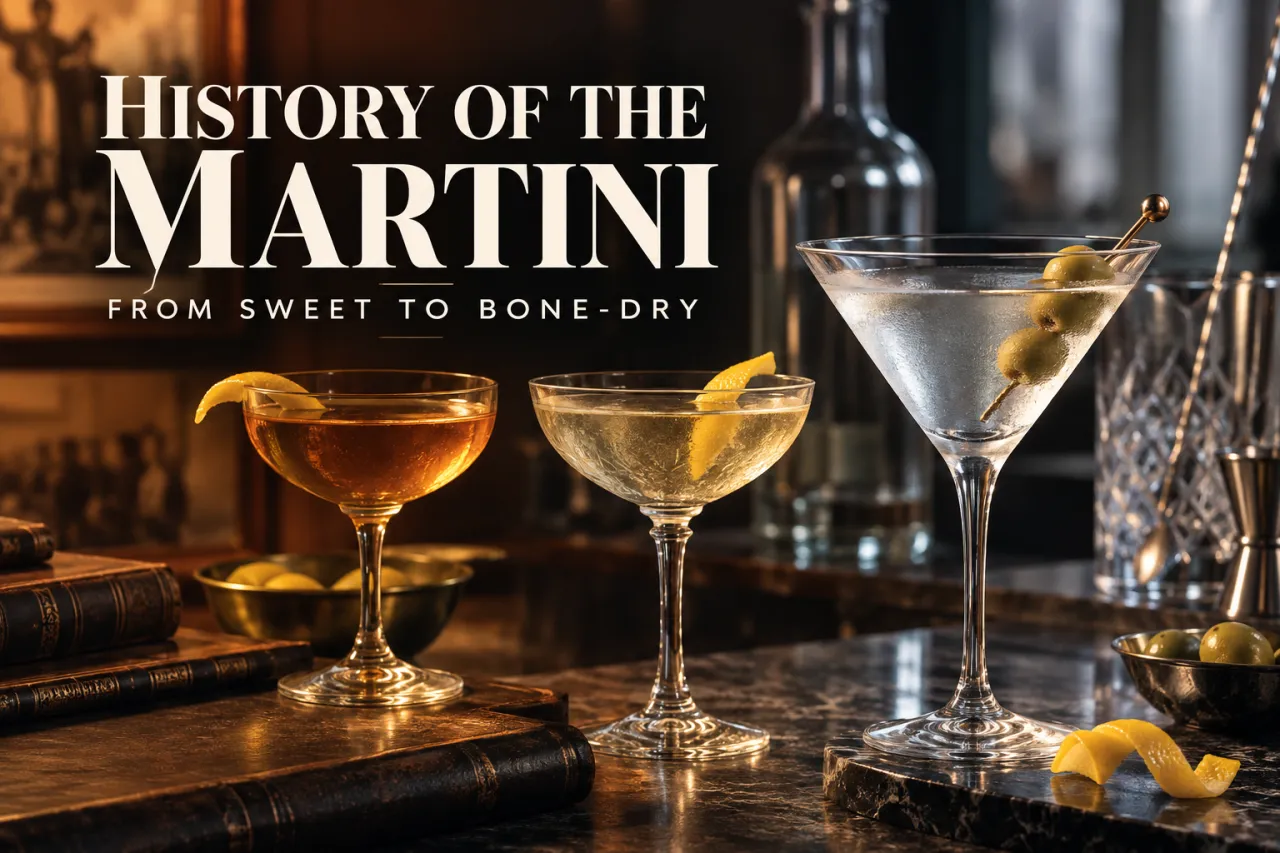
History of the Martini: From Sweet to Bone-Dry
By Dave C & Boozeopedia AI Workflow
See how we write our articles
Originally published February 2025. Updated September 2026 with revised historical research, corrected chronology, and updated cocktail references.
The Martini did not start as the bone-dry combination of gin and dry vermouth most drinkers recognize today. Its early history is considerably messier, and sweeter.
Late-19th-century bartender manuals contain a whole family of drinks combining gin and vermouth under names such as Martinez, Martini, and Marguerite. Over the next several decades, sweet vermouth gave way to dry, gin styles changed, ratios became increasingly spirit-heavy, and the Martini gradually took on its modern form.
There probably wasn't one bartender, bar, or afternoon when the Martini suddenly came into existence. The historical record looks more like evolution than invention.
Where Did the Martini Come From?
The Martinez Cocktail is one of the most important drinks in the Martini's family tree.
O.H. Byron's 1884 The Modern Bartenders' Guide included a Martinez as a variation on the Manhattan, replacing whiskey with gin. Other late-19th-century Martinez recipes combined gin with sweet vermouth and ingredients such as maraschino, curaçao, and bitters.
That resemblance has led generations of drinks writers to describe the Martinez as a Martini ancestor. It's a useful way to understand the progression, but it shouldn't be mistaken for proof that one specific Martinez recipe was transformed directly into the Martini.
By 1888, bartender Harry Johnson was printing a drink explicitly called the Martini Cocktail in his New and Improved Bartender's Manual. It looked very different from the Martini ordered at most bars today: Old Tom gin and vermouth were joined by curaçao, gum syrup, bitters, and lemon peel.
In other words, the Martini began sweet.
How the Martini Became Dry
The transition toward the modern Dry Martini was already underway by the end of the 19th century.
Recipes from this period increasingly paired drier styles of gin with French dry vermouth. One important example is the Marguerite, another close Martini relative. An 1898 recipe used equal parts Plymouth gin and French vermouth with orange bitters and an olive. By 1904, a published Marguerite recipe had shifted to roughly two parts gin to one part dry vermouth, plus orange bitters.
That is much closer to something a modern Martini drinker would recognize.
The important point is that the Dry Martini was developing before Prohibition began in the United States in 1920. Prohibition affected American bar culture enormously, but it did not create the Martini or introduce the basic combination of dry gin and dry vermouth.
Early Martinis could also contain orange bitters, an ingredient that later disappeared from many standard recipes and has since returned at cocktail bars interested in older formulations.
The Martini Kept Getting Drier
Once gin and dry vermouth became the Martini's defining ingredients, another question took over: how much vermouth?
Early Dry Martinis could be relatively wet by today's standards, sometimes approaching equal parts gin and vermouth. Over the 20th century, tastes steadily shifted toward more gin and less vermouth.
By the years after World War II, Martini dryness had become almost competitive. Ratios such as 5:1 became common, and drinkers increasingly asked for "extra dry" Martinis with only a small amount of vermouth. Jokes about merely showing the gin a bottle of vermouth were part of the culture for a reason.
That trend still shapes how people order the drink. A dry Martini generally means less vermouth, while a wet Martini contains more.
Boozeopedia's classic Martini recipe uses a 6:1 ratio of gin to dry vermouth. It's stirred with ice, strained cold, and finished with either lemon or olives.
There is no universally correct ratio. The Martini's history is essentially a century-long argument over two ingredients.
Prohibition, Hollywood, and the Martini Image
Although Prohibition did not invent the Dry Martini, the years around it helped shape the drink's cultural identity.
When national Prohibition ended in 1933, the Martini fit easily into the glamorous cocktail culture depicted in books and movies. The 1934 film The Thin Man, featuring Nick and Nora Charles and a great deal of cocktail drinking, became particularly associated with Martini culture.
That association only grew during the middle decades of the century. The Martini became visual shorthand for cocktail hour, hotel bars, business lunches, nightclubs, and a certain polished version of adult sophistication.
The image was powerful enough to survive even when the drink itself kept changing.
James Bond, the Vesper, and "Shaken, Not Stirred"
No fictional character is more closely tied to the Martini than James Bond.
Ian Fleming's 1953 novel Casino Royale introduced the drink now known as the Vesper Martini. Bond orders a custom combination of gin, vodka, and Kina Lillet and specifies that it should be shaken until very cold.
That is worth distinguishing from a standard Martini. The Vesper uses both gin and vodka plus an aromatized wine, and shaking is part of the drink's identity. Modern versions commonly use Lillet Blanc because the original Kina Lillet no longer exists in the same form.
The Bond films later turned "shaken, not stirred" into one of the most recognizable drink orders in popular culture.
For a conventional gin Martini, stirring remains the usual technique because it chills and dilutes the drink while maintaining a clear, silky texture. Shaking chills and dilutes too, but adds more aeration and changes the texture. Bond wasn't revealing a secret rule for all Martinis. He was ordering his Martini the way he wanted it.
How Vodka Changed the Martini
Vodka did not suddenly arrive with Bond.
Its popularity in the United States grew rapidly during the 1950s and 1960s, and bartenders increasingly substituted it for gin in familiar cocktails. The Vodka Martini became one of the most visible examples.
The difference is easy to taste. Gin brings juniper and other botanicals, making it a major source of flavor in a traditional Martini. Vodka produces a cleaner, more neutral drink in which vermouth, garnish, temperature, and dilution stand out differently.
By the 1960s and 1970s, the Vodka Martini was established enough that the question "gin or vodka?" had become part of ordering a Martini.
Neither choice needs a purity test. Historically, gin came first. Practically, drink what you like.
Martini Variations That Actually Belong to the Family
The Martini's simple structure makes small changes surprisingly noticeable.
The Dirty Martini adds olive brine to gin and dry vermouth. That gives the drink a salty, savory character rather than simply changing the garnish.
The Gibson Martini stays much closer to the standard gin-and-vermouth structure but finishes the drink with cocktail onions instead of olives or lemon.
The Vesper changes the formula more substantially by combining gin and vodka with Lillet.
Then there are drinks such as the Espresso Martini, Appletini, and other modern "Martinis" that don't share the classic gin-and-vermouth structure at all. During the late 20th century, the word Martini increasingly became shorthand for cocktails served up in a V-shaped cocktail glass.
That naming trend helped keep the Martini name everywhere, even when the contents of the glass had little connection to the original drink.
Does a Martini Have to Come in a Martini Glass?
No.
The V-shaped Martini glass is strongly associated with the cocktail, but a coupe or Nick & Nora glass can serve the same practical purpose: holding a chilled drink without ice.
The stem also lets you hold the glass without wrapping your hand around the bowl, which helps a cold drink stay cold a little longer.
The glass does not define the cocktail. Gin, vermouth, dilution, temperature, ratio, and garnish matter considerably more.
What Makes a Modern Martini a Martini?
For all the changes in the Martini's history, the classic version has become remarkably stripped down.
At its simplest, a modern Dry Martini is:
- gin
- dry vermouth
- ice for chilling and dilution
- a lemon twist or olives
From there, nearly every decision changes the drink. More vermouth makes it wetter. Less makes it drier. Vodka changes the base. Olive brine makes it dirty. Cocktail onions turn it toward a Gibson. Shaking instead of stirring changes the texture.
That flexibility is one reason the Martini has lasted. It has a clear identity without having one mandatory formula.
The Martini's History Is Evolution, Not Invention
The most useful way to understand Martini history is not to search for one mythical inventor.
The drink emerged from a late-19th-century family of gin-and-vermouth cocktails, including the Martinez and Marguerite. It became drier as bartenders adopted dry vermouth and drier styles of gin, then more spirit-heavy as 20th-century tastes pushed vermouth into an increasingly supporting role.
Vodka, James Bond, Hollywood, and decades of variations kept changing what people meant when they ordered one.
The result is a cocktail with a surprisingly complicated past for something that can now be made with only two bottles.
Sources
- O.H. Byron, The Modern Bartenders' Guide or Fancy Drinks and How to Mix Them (1884).
- Harry Johnson, New and Improved Bartender's Manual (1888).
- Cocktails: How to Make Them (1898), including early Marguerite and Martini recipes.
- Difford's Guide, “Martini Cocktail Evolution: From Sweet to Dry.”
- Liquor.com, “The Evolution of Martini Styles Throughout the Decades.”
- Ian Fleming Publications, material on Bond's drinks and “Shaken, Not Stirred.”