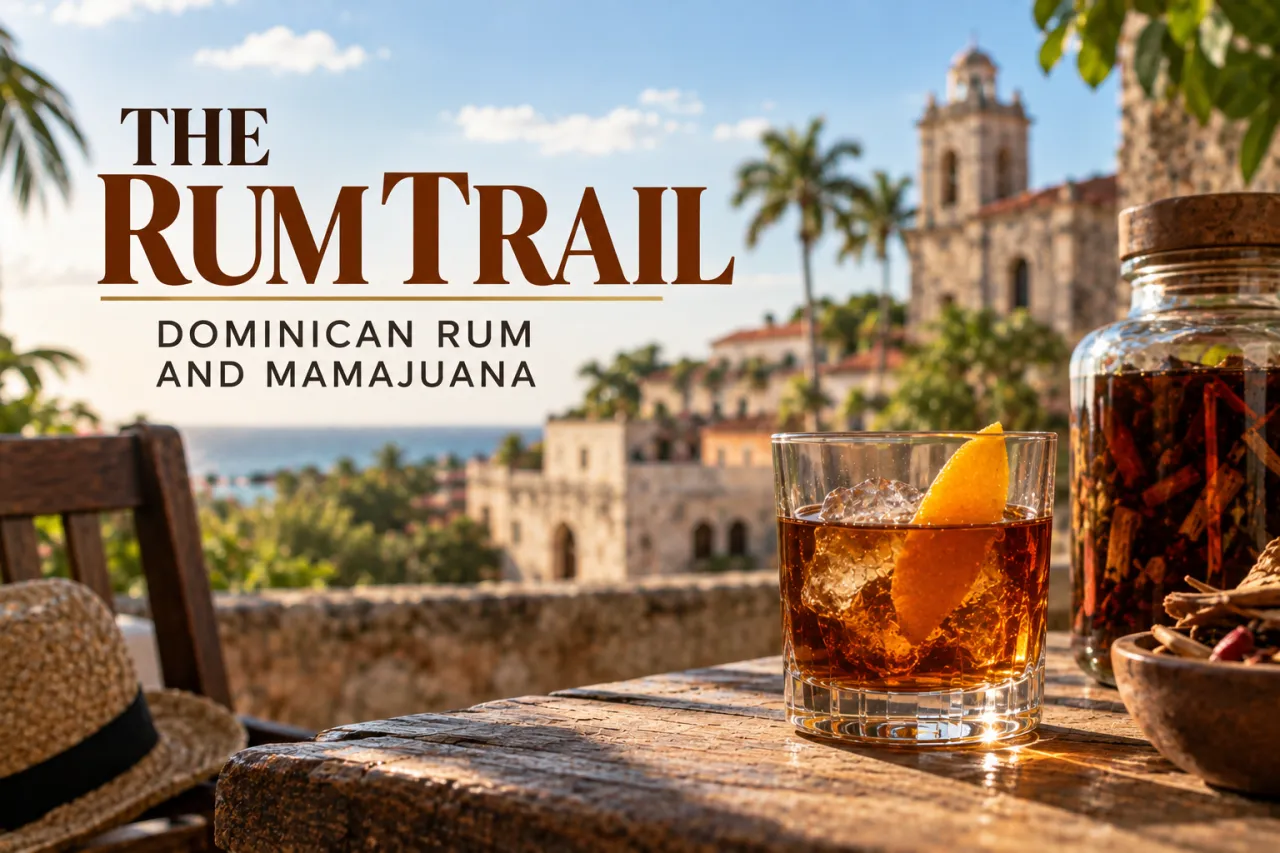
The Rum Trail: Dominican Rum and Mamajuana
By Dave C & Boozeopedia AI Workflow
See how we write our articles
Dominican rum is often described as smooth, light, and approachable. Plenty of bottles fit that description, but it doesn't tell you much about the category as a whole.
The Dominican Republic has a commercial rum tradition stretching back to the 19th century, several major producers with distinctly different approaches, and a formal Denominación de Origen protecting Ron Dominicano. Even the raw material isn't universal: while molasses is common in rum production, at least one major Dominican producer makes its rum from fresh sugarcane juice.
Then there's Mamajuana, one of the country's best-known drinks. It contains rum, but it isn't a style of rum. It's an infusion traditionally built around rum, wine, honey, and woody botanicals.
After Jamaica, Barbados, and Martinique, the Dominican Republic gives us another example of why Caribbean rum is better understood country by country than through one neat definition.
How Dominican Rum Became an Industry
Sugarcane has been grown on Hispaniola for centuries, but the modern Dominican rum industry took clearer shape during the 19th and early 20th centuries.
Bermúdez traces its history to 1852 in Santiago de los Caballeros, when pharmacist Erasmo Bermúdez created an alcoholic preparation called Amargo Panacea. According to the company, that business eventually developed into the rum producer known today as Bermúdez. You can read Bermúdez's account of its history.
Brugal & Co. was founded by Andrés Brugal Montaner in 1888. Brugal's own historical timeline later places his settlement in Puerto Plata in 1897, and the company became closely associated with the city and with barrel-aged Dominican rum. Brugal documents that timeline here.
Ron Barceló is younger. Julián Barceló arrived in the Dominican Republic in 1929 and founded Barceló & Co. in 1930. The company says its Blanco and Dorado releases helped establish the brand in the domestic market in 1950. Its official company history lays out that progression.
Those producers are often grouped together as major names in Dominican rum, but their shared geography doesn't mean they make identical spirits.
Ron Dominicano Has a Denominación de Origen
The Dominican Republic formally received a Denominación de Origen for Ron Dominicano in 2021.
The Dominican National Office of Industrial Property, ONAPI, announced the formal recognition in November 2021 after an application process that had lasted several years.
Boozeopedia also has an explainer for Denominación de Origen.
Dominican rum is also covered by the country's technical standard, NORDOM 477. The INDOCAL listing for NORDOM 477 defines terminology including rum, Ron Dominicano, and aging, along with requirements for rum sold or produced in the country.
For the drinker, the important point is that Ron Dominicano is now a formally protected geographic designation, not simply a marketing description.
That still doesn't mean every qualifying bottle should taste the same.
Dominican Rum Doesn't Follow One Production Formula
It's tempting to define Dominican rum as light, molasses-based column-still rum. That description fits some products better than others.
Brugal, for example, emphasizes a particularly clean distillate followed by barrel maturation and blending. Its cask program includes ex-bourbon American oak as well as European oak previously used for sherry in some expressions. Brugal describes its production approach here.
Ron Barceló provides a useful contrast. The producer says its rum is made from 100% sugarcane juice from its own plantations, demonstrating why a blanket claim that all Dominican rum begins with molasses doesn't hold up. Barceló describes its raw material here.
Raw material is only one variable. Fermentation, distillation, proof, barrel selection, maturation, and blending all affect the finished spirit.
It's therefore more useful to think of Dominican rum as a national rum tradition containing several producer styles rather than one recipe everyone follows.
Aging Plays a Major Role
Barrel aging is particularly important to many Dominican rums.
The country's warm climate means spirit matures under conditions very different from those in a cool European warehouse. Heat encourages more active interaction between spirit and wood and also increases evaporation.
That doesn't mean a Dominican rum aged for five years is simply equivalent to a much older spirit from somewhere colder. Climate changes maturation, but age statements from different regions aren't directly interchangeable.
What you can expect from barrel maturation is the development of flavors such as vanilla, oak, spice, caramel, dried fruit, and toasted notes.
Brugal states that all of its rums mature for at least two years and emphasizes the role of Dominican heat in its warehouses. Its current cask program includes both American ex-bourbon and European ex-sherry oak, depending on the expression.
Other producers make different choices, which is another reason age alone doesn't tell you everything about a Dominican rum.
What Does Dominican Rum Taste Like?
There isn't one universal Dominican flavor profile.
Lighter expressions may emphasize:
- vanilla
- light caramel
- fresh or dried fruit
- gentle spice
- clean sugarcane character
Richer or longer-aged examples can develop:
- toasted oak
- dried fruit
- cocoa
- baking spice
- caramel or toffee
- roasted nuts
- tobacco- or leather-like notes in some mature expressions
Some producers deliberately pursue a very clean distillate and let the barrel and blending process build much of the final flavor. Others retain more obvious cane or fermentation character.
That's why smooth can be a reasonable description of a particular rum but isn't very useful as a definition of Dominican rum.
Three Historic Dominican Rum Producers
Bermúdez
Bermúdez traces its roots to Erasmo Bermúdez and his Amargo Panacea in 1852.
The company says that early alcoholic preparation eventually led to La Sin Rival and the development of its rum business in Santiago.
Whether or not you treat 1852 as the birth date of modern Dominican rum itself, Bermúdez clearly represents an important early chapter in the country's commercial spirits history.
Brugal
Brugal & Co. dates to 1888.
Modern Brugal emphasizes clean distillation, cask selection, tropical maturation, and blending. That makes it a useful example of one important Dominican approach: begin with a relatively restrained spirit and build complexity through wood and maturation.
Its long association with Puerto Plata has also made the company an important part of the region's rum identity.
Ron Barceló
Barceló & Co. dates to 1930 and grew into one of the Dominican Republic's major rum producers and exporters.
Its use of fresh sugarcane juice makes it particularly useful when discussing Dominican rum because it immediately challenges the idea that the category follows one universal raw-material formula.
The company also operates a historical and production visitor centre in San Pedro de Macorís.
The point of comparing these producers isn't to choose a winner. It's to see how different businesses operating within the same national rum tradition can make substantially different production choices.
Mamajuana Is an Infusion, Not a Rum Style
Mamajuana belongs in a discussion of Dominican drinks, but it needs its own category.
It is not a type of rum.
Boozeopedia's Mamajuana recipe combines a Mamajuana bark blend with Dominican rum, red wine, and honey.
The woody botanical mixture is first cured, then used for the finished infusion. Depending on the blend and preparation, the result can be herbal, woody, spicy, wine-like, and sweet.
The bark mixture can often be refilled and infused again, which makes Mamajuana very different from simply buying a flavored rum.
You'll also encounter plenty of medicinal and aphrodisiac claims surrounding Mamajuana. Those claims are part of the drink's folklore and marketing history, not established health benefits.
Three Ways to Explore Dominican Rum at Home
Traditional-Style Mamajuana
The most distinctly Dominican preparation currently in the Boozeopedia database is Mamajuana.
The recipe uses Dominican rum, red wine, honey, and a traditional-style bark blend, with a curing stage before the final infusion.
This isn't a quick shaken cocktail. It develops over several days, and the botanical mixture may be reused for later batches.
Mamajuana-Style Infusion
If a traditional bark mixture isn't available, our Mamajuana Style Infusion is explicitly designed as an adaptation.
It combines Dominican rum and red wine with honey, cinnamon, clove, star anise, and orange peel.
It doesn't claim to duplicate a traditional bark blend. Instead, it gives home drinkers an accessible way to explore the basic rum-wine-honey-and-spice structure with easier-to-find ingredients.
Cuba Libre With Dominican Rum
The Cuba Libre is Cuban, not Dominican, and the Boozeopedia recipe calls for light rum rather than specifically Dominican rum.
But its simple combination of rum, cola, and fresh lime makes it a useful comparison drink.
Substitute a Dominican white or lightly aged rum and pay attention to what changes. A cleaner expression may keep the drink crisp and straightforward, while a more barrel-influenced rum can add vanilla, caramel, and oak.
That's an adaptation of the Boozeopedia recipe, not its original specification.
How to Choose a Dominican Rum
Start with what you plan to do with the bottle.
For highballs and Cuba Libres: A white or lightly aged expression will usually keep the drink bright and refreshing.
For spirit-forward cocktails or sipping: Look for a more mature rum where oak, vanilla, dried fruit, and spice have had more opportunity to develop.
For learning the category: Compare two different producers rather than simply comparing two age statements from the same brand. Differences in raw material, distillation, barrels, and blending can be more revealing than age alone.
For Mamajuana: Choose a Dominican rum with enough body to remain noticeable alongside wine, honey, bark, and spices. There's no need to sacrifice an expensive older bottle to the infusion.
You can also explore the Dominican Rum ingredient page as Boozeopedia's recipe collection continues to grow.
Dominican Rum Is More Varied Than Its Reputation
Dominican rum has long been associated with polished, approachable aged spirits.
That's part of the story, not the whole thing.
The category includes historic producers dating to the 19th century, different raw materials and production philosophies, extensive tropical maturation, and a Denominación de Origen that formally protects Ron Dominicano.
Alongside straight rum sits Mamajuana, a separate Dominican tradition that uses rum as one component of something herbal, woody, sweet, and distinctly its own.
The best way to explore the category is simple: taste two Dominican rums from different producers side by side, then use them in the same uncomplicated drink. Keeping everything else constant makes the differences much easier to recognize.
That brings this Rum Trail through four distinct Caribbean traditions: Jamaica, Barbados, Martinique, and the Dominican Republic.