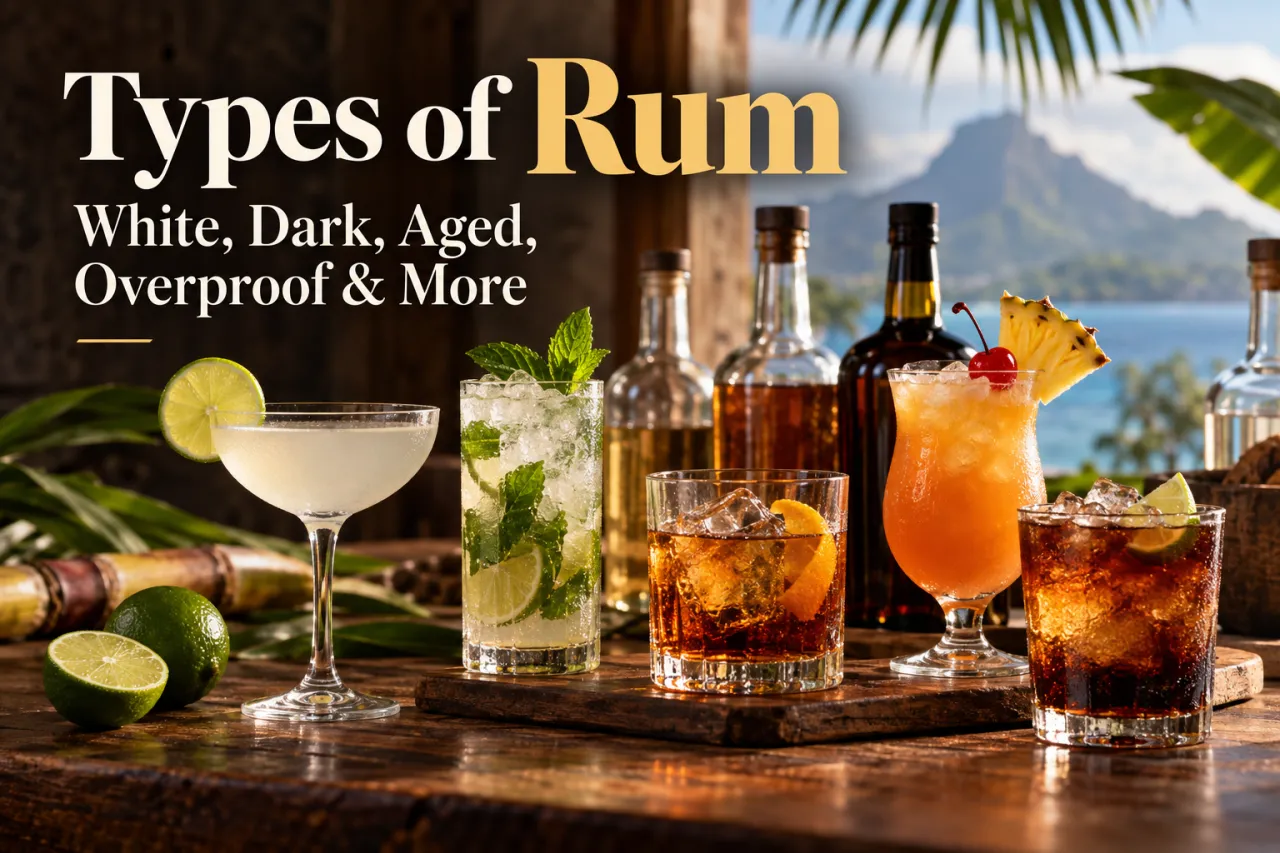
Types of Rum: White, Dark, Aged, Overproof & More
By Dave C & Boozeopedia AI Workflow
See how we write our articles
Rum comes with an unusually confusing collection of labels.
White, gold, dark, aged, overproof, agricole, Jamaican, Demerara, spiced: you'll see all of them on bottles, but they don't describe rum in the same way. Some refer mainly to color. Others tell you about aging, alcohol strength, raw material, flavoring, or where the rum was made.
That means a rum can fit several descriptions at once. A bottle might be white and overproof, dark and Jamaican, or aged rhum agricole.
Understanding those overlapping categories is much more useful than trying to force every bottle into one neat box.
What Is Rum?
At its core, rum is a distilled spirit made from fermented sugarcane material. Depending on the producer, that starting material may be molasses, cane syrup, or fresh sugarcane juice.
Even that basic definition changes slightly between jurisdictions. European Union rules define rum as a spirit distilled from fermented molasses, cane-sugar syrup, or sugarcane juice at less than 96% ABV, with a minimum bottling strength of 37.5% ABV. U.S. rules use their own production and bottling requirements. (eur-lex.europa.eu)
The important point for the drinker is that rum is a broad family of spirits, not one flavor.
Fermentation, still type, blending, barrel aging, climate, filtration, proof, raw material, and regional production rules can all change what's in your glass.
Rum Types at a Glance
| Label | What it usually tells you | What it doesn't guarantee |
|---|---|---|
| White / Light Rum | Clear appearance, often a lighter mixing profile | That the rum is unaged |
| Gold / Amber Rum | Golden color and usually some barrel influence | A specific age |
| Dark / Black Rum | Darker color and usually a more assertive profile | That it is older than a lighter rum |
| Aged / Añejo Rum | The spirit has spent time maturing in wood | One universal minimum aging period |
| Overproof Rum | Higher alcohol strength than standard bottlings | A particular flavor or production method |
| Rhum Agricole | Rum made from fermented fresh sugarcane juice | That it necessarily comes from Martinique |
| Jamaican, Barbados, Demerara, etc. | Geographic origin or tradition | One universal flavor profile |
| Spiced / Flavored Rum | Rum has been flavored after distillation | That it follows the same legal category as unflavored rum everywhere |
That's why shopping by color alone can get you into trouble.
White or Light Rum
White rum, also called light or sometimes silver rum, is clear in the bottle and is one of the most familiar cocktail rums.
The classic expectation is a relatively clean, crisp spirit that works easily with citrus, mint, soda, tropical fruit, and other mixers. That's why white rum is so common in Daiquiris, Mojitos, Cuba Libres, and Piña Coladas.
But clear doesn't necessarily mean unaged.
Some white rums spend time in oak before being filtered to remove much of the barrel-derived color. Bacardí, for example, states that its Superior white rum is aged in American oak and charcoal filtered. (bacardi.com)
So the useful distinction isn't really aged versus unaged. It's that white rum has been produced to finish clear and usually, though certainly not always, relatively light in profile.
Boozeopedia's classic Daiquiri is an ideal way to taste what a white rum is doing. The recipe uses light rum with fresh lime juice and simple syrup, so there isn't much to hide differences between bottles.
Use white rum when: you want the rum to stay bright and mix easily with citrus, herbs, soda, or fresh fruit.
Gold or Amber Rum
Gold and amber rum occupy the broad territory between clear white rum and very dark rum.
These bottles commonly pick up color and flavor through barrel maturation, with profiles that may include vanilla, caramel, fruit, toasted wood, and gentle spice.
But gold is not an age statement.
A golden color may suggest barrel influence, but color alone can't tell you exactly how long a rum was matured or how intense that maturation was. Producers may also use permitted caramel coloring to adjust appearance in some markets. EU rum regulations, for example, explicitly allow caramel for color adjustment. (eur-lex.europa.eu)
For cocktails, gold rum is useful when white rum feels a little too restrained but a heavier dark rum would take over.
It works particularly well in rum-and-cola drinks, punches, tropical cocktails, and Daiquiri variations where a little vanilla and oak are welcome.
Use gold rum when: you want a flexible mixing rum with more barrel character than a typical white rum.
Dark and Black Rum
Dark rum sounds straightforward until you try to define it.
These rums range from brown to almost black and often bring stronger flavors associated with molasses, caramel, spice, toasted wood, dried fruit, or roasted notes.
But again, dark color does not automatically mean long aging.
A mature rum can be comparatively light in color, while another bottle can be very dark because of blending choices and color adjustment. Even major rum producers caution that color can be misleading when judging age or flavor. (bacardi.com)
That makes "dark rum" most useful as a broad cocktail description rather than a precise production category.
Boozeopedia's Dark ’N’ Stormy shows why this category works so well in mixed drinks. Gosling's Black Seal Rum brings enough dark caramel, molasses, and spice character to remain obvious against a tall pour of spicy ginger beer.
Dark rum also works well in punches, coffee drinks, tropical cocktails, and recipes where the rum needs to compete with rich or strongly flavored ingredients.
Use dark rum when: you want weight, deeper sugar flavors, spice, or a more noticeable rum presence.
Aged Rum and Añejo Rum
Aged rum is a more useful distinction than color because it tells you something concrete happened to the spirit: it spent time maturing in wood.
During barrel aging, rum can develop flavors including:
- vanilla
- toasted oak
- caramel or toffee
- baking spice
- dried fruit
- cocoa
- roasted nuts
The exact result depends on much more than time.
Barrel type, previous barrel contents, warehouse conditions, climate, entry proof, distillate style, and blending all affect the final rum.
There also isn't one worldwide minimum that makes every rum officially "aged." Individual countries and protected geographic designations can establish their own rules.
Martinique provides a good example. Under its AOC, élevé sous bois rhum agricole requires at least 12 months under wood, while vieux requires at least three years. (inao.gouv.fr)
That doesn't create a universal rule for aged rum elsewhere.
Boozeopedia's Old Cuban uses añejo rum with mint, lime, bitters, simple syrup, and Prosecco. Compared with the white rum you'd expect in a Mojito, the aged base gives the drink more oak, vanilla, spice, and body while the mint, lime, and sparkling wine keep it lively.
Use aged rum when: you want oak and maturation character to be part of the cocktail, especially in spirit-forward drinks or recipes with relatively few ingredients.
And don't assume older is automatically better. A ten-year-old sipping rum may be excellent, but it isn't necessarily the right bottle for a bright Daiquiri.
Overproof Rum
Overproof is about strength, not color, age, or raw material.
There isn't one universal global cutoff for the term, but overproof rums are bottled at significantly higher alcohol levels than ordinary rum. Wray & Nephew describes the category as stronger than standard rum, often reaching 50% ABV or above. (wrayandnephew.com)
That extra strength can carry a large amount of aroma and flavor into a cocktail.
Overproof rum may be white or aged. It may come from Jamaica, Guyana, or somewhere else entirely. The term only tells you part of the story.
Boozeopedia's Illegal cocktail demonstrates a smart way to use it. Jamaican overproof white rum appears alongside mezcal rather than functioning as the entire base, adding a concentrated dose of rum aroma and strength without turning the drink into a glass of rocket fuel.
That approach works well at home too. In tiki drinks and punches, an overproof rum can be used as one part of a split base rather than replacing every ounce of standard-strength rum.
Use overproof rum when: you want extra aromatic intensity or rum character, and measure it carefully. Higher proof changes both flavor and the total alcohol in the finished drink.
Rhum Agricole and Fresh-Cane Rum
Most familiar Caribbean rum starts with molasses, but rhum agricole begins with freshly pressed sugarcane juice.
That different raw material can produce a distinctly fresh style of rum with flavors suggesting cane, grass, herbs, flowers, citrus, fruit, pepper, and earthy notes.
Martinique is particularly famous for agricole, and its AOC establishes detailed requirements governing cane production, fermentation, distillation, and maturation.
But agricole doesn't automatically mean Martinique.
Fresh-cane rums and agricole traditions exist elsewhere, while the AOC Martinique designation refers to rum that meets Martinique's specific geographic and production rules. The official INAO description distinguishes blanc, élevé sous bois, and vieux categories within Martinique rhum agricole. (inao.gouv.fr)
For the deeper version of that story, Boozeopedia's Rum Trail guide to Martinique and rhum agricole covers the production rules and styles in detail.
To taste the basic difference, make a Ti’ Punch. Boozeopedia's version uses rhum agricole, cane syrup, and lime, leaving the spirit almost completely exposed.
Use rhum agricole when: you want fresh cane, vegetal, fruity, peppery, or herbal character rather than relying mainly on molasses and barrel flavors.
Regional Rum Styles Matter Too
Color tells only part of the story. Sometimes where a rum comes from and how its producer works tells you much more.
That's one reason Boozeopedia's Rum Trail treats Caribbean rum country by country instead of trying to cram the entire region into a few old-fashioned "style" categories.
Jamaican rum, for example, can range from balanced blends to extraordinarily aromatic high-ester pot-still spirits. Fermentation methods, rum marques, blending, and still type can matter more than whether the liquid happens to look gold or dark.
Barbados rum has its own long history and includes producers working with different combinations of pot stills, column stills, blending, raw materials, and tropical aging.
Dominican rum offers another contrast, with different producers using their own approaches to raw material, distillation, barrels, aging, and blending.
Then there is Demerara rum, tied to Guyana's Demerara region. Demerara Distillers still operates an unusually varied collection of heritage stills, including wooden pot and continuous stills capable of producing distinctly different rum marques. (theeldoradorum.com)
The practical lesson is simple: country or region can be as important as color when you're trying to predict how a rum will taste.
What About Spiced and Flavored Rum?
Spiced rum deserves a place on the shelf, but it's slightly different from categories such as aged or overproof rum.
These products begin with rum and then add spices, flavorings, or both. Vanilla, cinnamon, clove, nutmeg, citrus, and other flavors are common.
Legally, how they're labeled depends on the market.
EU rules do not allow flavoring within the basic legal category of "rum." In the United States, TTB gives "Spiced Rum" as an example of a fanciful name accompanied by the description rum with spices added. (eur-lex.europa.eu)
That doesn't make spiced rum somehow lesser. It just means the added flavor is part of what you're buying, rather than a flavor created entirely through fermentation, distillation, aging, and blending.
The same caution applies to coconut and other flavored rums. Check the bottle rather than assuming every coconut-flavored product follows the same strength or production rules as an unflavored rum.
Use spiced or flavored rum when: you specifically want those added flavors in the finished drink rather than trying to reproduce them with bitters, syrups, or spices.
Which Type of Rum Should You Buy?
Start with the drink you're making rather than trying to find one bottle that does everything.
For Daiquiris, Mojitos, and bright citrus drinks: Start with a flavorful white or light rum.
For rum and ginger beer, richer punches, or bold tropical drinks: Dark rum gives you more weight and a deeper flavor profile.
For Old Fashioned-style drinks or cocktails where the spirit stays prominent: An aged rum brings oak, vanilla, fruit, and spice.
For tiki recipes that call for multiple rums: Treat each rum as part of a blend. A light rum, aromatic Jamaican rum, aged rum, or small amount of overproof can each contribute something different.
For tasting fresh sugarcane character: Reach for rhum agricole or another fresh-cane rum.
And when a recipe calls for something specific such as Jamaican rum or rhum agricole, don't assume any similarly colored bottle will behave the same way.
Is White Rum Better for Cocktails Than Dark Rum?
No. They're useful for different jobs.
White rum tends to work well when you want citrus, mint, carbonation, or fresh fruit to stay bright.
Dark and aged rums are useful when you want the base spirit to contribute more oak, spice, caramel, fruit, or molasses-like depth.
Plenty of excellent cocktails use more than one style at once.
Is Dark Rum Always Older Than White Rum?
No.
Some white rums are barrel aged and then filtered clear, while darker appearance can also be influenced by blending and permitted color adjustment.
If age matters to you, look for an actual age statement or producer information rather than judging the bottle by color.
Is Rhum Agricole Really Rum?
Yes.
It's made from fermented sugarcane juice rather than molasses, but it belongs to the broader rum family. Martinique's AOC rhum agricole is one particularly regulated example of the style.
Its grassy reputation is only the beginning. Depending on distillation and aging, agricole can be floral, fruity, peppery, earthy, spicy, woody, or rich.
There's More Than One Way to Classify Rum
The easiest mistake with rum is believing one label tells you everything.
White, gold, and dark mostly help describe appearance and broad drinking style. Aged tells you about maturation. Overproof tells you about strength. Agricole tells you about raw material and production tradition. Jamaican, Barbadian, Martinican, Dominican, and Demerara tell you something about place.
Those categories overlap, and that's the interesting part.
If you want to learn rum rather than memorize labels, compare bottles that change one variable at a time. Try two white rums in the same Daiquiri, an aged rum beside a white one, or a molasses-based rum beside rhum agricole.
Once everything else in the glass stays constant, the differences become much easier to taste.